AI data centers are redefining cooling infrastructure

Redefining hydronic infrastructure for direct-to-chip liquid cooling

The performance of direct liquid cooling systems depends not only on cooling equipment, but on the entire hydronic infrastructure transporting fluid from gray space to white space. See how material selection influences purity, performance, and system reliability.

Cooling infrastructure under pressure

The data center industry is evolving rapidly, but the rise of AI is fundamentally changing how facilities are designed and operated. Power densities are shifting from 16 kW racks to 100 kW+ today, with 300–600 kW on the horizon, pushing cooling systems designed for a low-kW world to their limits.

At the same time, operators face tighter sustainability targets, while a fragmented liquid cooling ecosystem, spanning cold plates, CDUs, and connection methods, adds complexity for engineers. Amid this, one critical element is often overlooked: the hydronic infrastructure transporting the coolant.

From air cooling to scalable direct-to-chip liquid cooling

What determines performance of piping systems in DLC?

Liquid cooling is gaining momentum because liquids transfer heat far more efficiently than air, with water offering ~3,500× higher thermal capacity. But system performance depends on more than cooling units. Cold plate microchannels are extremely sensitive, even microscopic particles can reduce performance or cause failure. Therefore, the piping system material directly impacts:

Coolant purity and contamination risk

In direct liquid cooling systems, even microscopic particles can compromise cold plate performance or lead to long-term reliability issues. Engineers must ensure that the entire hydronic loop, from gray space to white space, does not introduce contaminants into increasingly sensitive cooling environments.

Download White Paper

Hydraulic performance

As rack densities increase, so do flow requirements and system complexity. Maintaining stable flow rates for the life of the system on long piping networks becomes critical to ensure consistent cooling performance and avoid unnecessary energy consumption.

Download White Paper

System reliability and leak prevention

Cooling infrastructure must operate continuously under demanding conditions, where even minor failures can result in costly downtime. Designing leak-free, long-term reliable systems, especially at connection points, remains one of the key challenges in hydronic system design.

Download White Paper

Installation time and scalability

Data center projects are under constant pressure to deliver faster, while still allowing for future expansion. Engineers must balance speed of installation with system quality and ensure that cooling infrastructure can scale alongside increasing compute densities.

Download White Paper

Proposal and detail engineering for technology cooling systems
Download white paper

The role of polymer piping in DLC

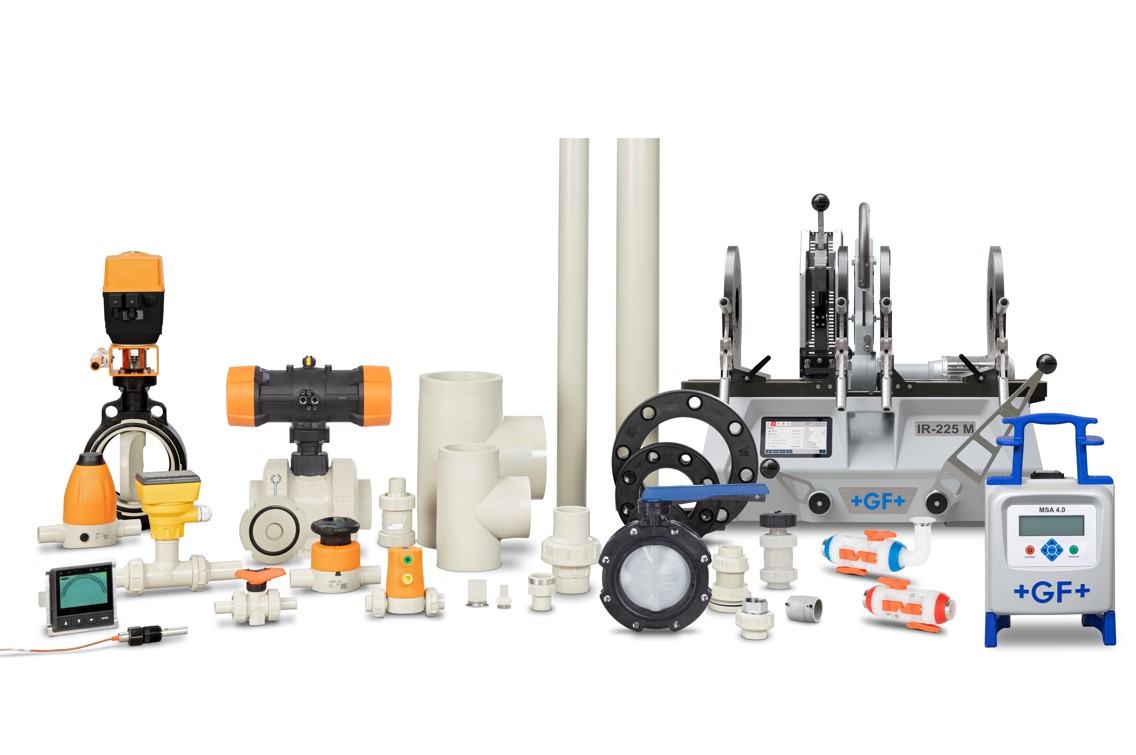
Learn how fluid conveyance components - from pipes and fittings to valves and in-rack manifolds - impact performance, reliability, and scalability from chiller to chip.

Polymers - a material often misunderstood

Metal piping has long been the standard in data center cooling systems. But this assumption is increasingly being challenged. High-performance polymers:

  • have been used for decades in pressurized, mission-critical environments
  • meet requirements for temperature, pressure, and ultra-high purity
  • are widely used in semiconductor manufacturing

The misconception often stems from equating industrial polymers with consumer-grade plastics. In reality, materials like PP-H and PVDF are engineered for high-performance hydronic systems.

Polymer piping systems are gaining traction for cooling applications in data center environments

Proven in high-density environments

The NETMOUNTAINS data center project, delivered in partnership with RITTAL, demonstrates the advantages of engineered polymer components in fluid transport for mission-critical cooling environments. It highlights key benefits in material performance, accelerated commissioning, and scalable infrastructure for high-density data centers.

Please accept all cookies to view the youtube video content.

The recent deployment at the co-location facility NETMOUNTAINS (Velbert, Germany) demonstrates how engineered polymer flow solutions support scalable direct liquid cooling infrastructure.

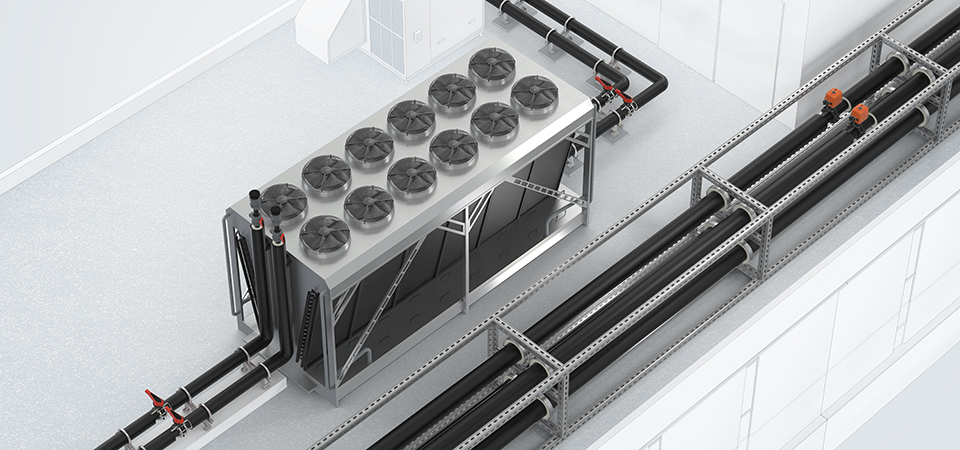
  • Cooling loop from dry cooler to in-rack manifolds

  • Integration across gray space and white space

  • Support for rack densities up to 66 kW

  • Accelerated installation through pre-fabrication

The result: a reliable, scalable hydronic cooling infrastructure for high-density workloads.

Read Story

More information

LiquidCore portfolio

LiquidCore Portfolio

Discover the full polymer solution for single-phase direct-to-chip liquid cooling. The system ensures reliable fluid flow between the CDU and the cold plate. It combines a comprehensive product portfolio with tailored engineering to enable optimized designs and precision pre-fabrication, facilitating fast installation.

Application possibilities

More Application Possibilities

Engineered thermoplastics are the superior material choice across Facility Water Sytsems and Technology Cooling Systems, connecting the gray and the white space. Learn more about the application possibilities

Online tools

Free Online Tools

GF's diverse online tools facilitate configuration and calculation for numerous applications. By entering material and product selection as well as design and dimensions, you can calculate the decisive factors for your project easily and quickly - from Facility Water System to In-rack manifold.

We are a member of the Open Compute Project

The Open Compute Project is a fast-growing global community of engineers dedicated to designing and delivering the most efficient server, storage, and data center hardware for scalable computing. GF Industry and Infrastructure Flow Solutions has proudly joined this innovative initiative in 2024.

Georg Fischer Piping Systems Ltd

Ebnatstrasse 111

8201 Schaffhausen

Switzerland