Cooling

The Growing Cooling Challenge in ASEAN

Engineering Pathways to Energy Efficiency

Rising Cooling Demand and Energy Efficiency Challenges in Southeast Asia's Tropical Climate

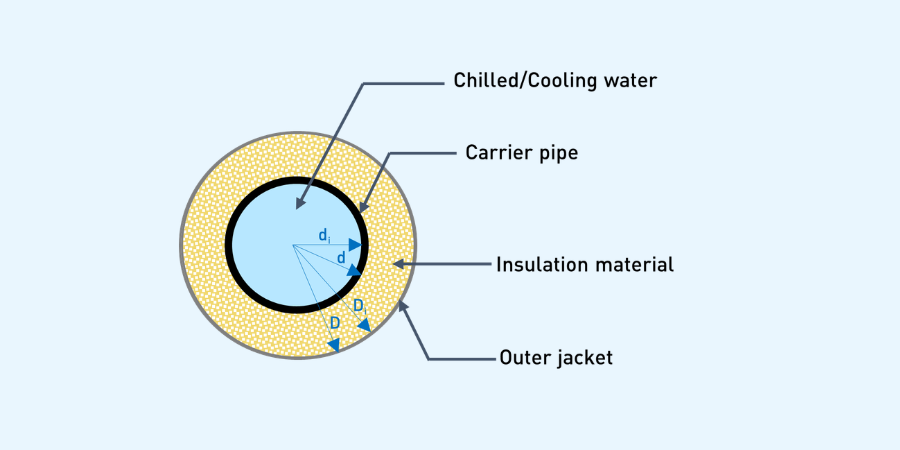
Condensation is a prevalent issue in the Southeast Asia region due to rising ambient temperatures and high relative humidity levels. This introduces safety risks such as water dripping and slip hazards, as well as health concerns related to mold and microbial growth. In order to prevent condensation, the outer surface temperature of a chilled water pipe must remain above the surrounding air’s dew point temperature. Moreover, air velocity plays a critical role in determining surface temperature. Therefore, both environmental and design parameters must be considered simultaneously.

From air cooling to scalable direct-to-chip liquid cooling

Principles of Heat Transfer

Heat transfer occurs when there is a temperature gradient, moving thermal energy from higher-temperature regions to lower-temperature regions. Three primary mechanisms govern this process: conduction, convection, and radiation.

Conduction

Heat transfers through direct contact. Heat moves from warmer to cooler molecules of substances until thermal equilibrium is reached. Metals are good conductors due to having free electrons, while plastics are good insulators due to poor conducting of heat.

Download White Paper

Convection

Heat transfer occurs through the movement of fluids such as air or water. It may occur naturally due to temperature-driven density differences or be enhanced by mechanical devices. Air velocity and airflow patterns over surface influence surface temperature.

Download White Paper

Radiation

Radiative heat transfer occurs via electromagnetic waves without a medium. It depends on surface emissivity: high-emissivity surfaces absorb and emit heat efficiently, while low-emissivity metallic surfaces reflect more and radiate less.

Download White Paper

Proposal and detail engineering for technology cooling systems
Download white paper

Analyzing Condensation Risk for Chilled Water Piping

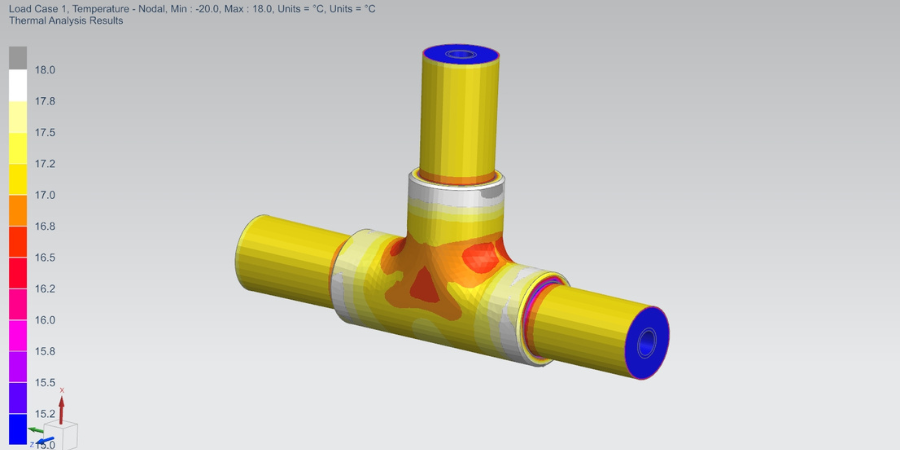
Learn how fittings and complex geometries introduce additional challenges due to irregular airflows

Understanding the Phenomenon of Condensation

When air comes into contact with a cold surface, its temperature decreases. As the air cools, its ability to retain moisture is reduced. Once the air can no longer hold the moisture, the water vapor changes from the gaseous state to the liquid state; known as condensation. The temperature at which water vapor begins to condense into liquid is called the dew point temperature. This relationship can be obtained using a psychrometric chart or calculated mathematically.

Polymer piping systems are gaining traction for cooling applications in data center environments

More information

LiquidCore portfolio

Formulae and Equations

  • Determine Dew Point Temperature
  • Determine Surface Temperature
Application possibilities

Comparative Analysis of different Scenarios

  • Comparison between different type of jackets
  • Comparison between different type of pipe
  • Comparison between different Air Velocities
  • Impact of Air Velocity and Geometry of Equal Tee
Application possibilities

Results and Discussions

  • Jacket material has a major impact
  • Carrier pipe material has minimal impact
  • Air velocity strongly influences condensation risk
  • Pipe fittings (e.g., Tees) are more vulnerable

Download whitepaper

Please accept all cookies to view the external content.

George Fischer Pte Ltd

152 Ubi Avenue 4

408826 Singapore

Singapore

GFPS_R024_sZBY1ItGwU.jpg